
Publisher disclosure: this comparison is written by WhatFlow. Competitor capabilities are based on the linked public documentation; the WhatFlow screenshots come from our demo store. Examples are illustrative, and results depend on your store and configuration.
WhatFlow and Gupshup at a glance
| Consideration | WhatFlow | Gupshup |
|---|---|---|
| Solution scope | An existing Shopify app with event and template workflows | Advertised conversational AI and messaging platform capabilities |
| Source of this comparison | Observed Shopify demo configuration; test your required workflow before launch | Linked vendor product documentation; confirm plan and account availability |
| Cost check | Use current WhatFlow pricing and the Shopify installation terms for your expected usage | Request a current Gupshup quote covering the required product, integration and message volume |
Ask what the proposal actually contains
The name of a platform does not tell you which parts of a project are included. A vendor might provide messaging connectivity, an AI layer, an application interface, implementation services or a combination of those things. The store still needs someone responsible for the finished customer journey.
For WhatFlow versus Gupshup, start with the proposed architecture. Identify the Shopify connection, the message configuration and the interface your staff will use after launch.
What Gupshup presents
Gupshup's current product overview describes conversational AI agents for sales, marketing and support, alongside voice and other customer-conversation use cases. It is a broader platform proposition than a single store notification app.
Ask the provider or implementation partner to name the products and services included in your offer. Evaluate those actual components instead of assuming that every feature on a platform website is part of the same subscription.
WhatFlow's packaged workflow
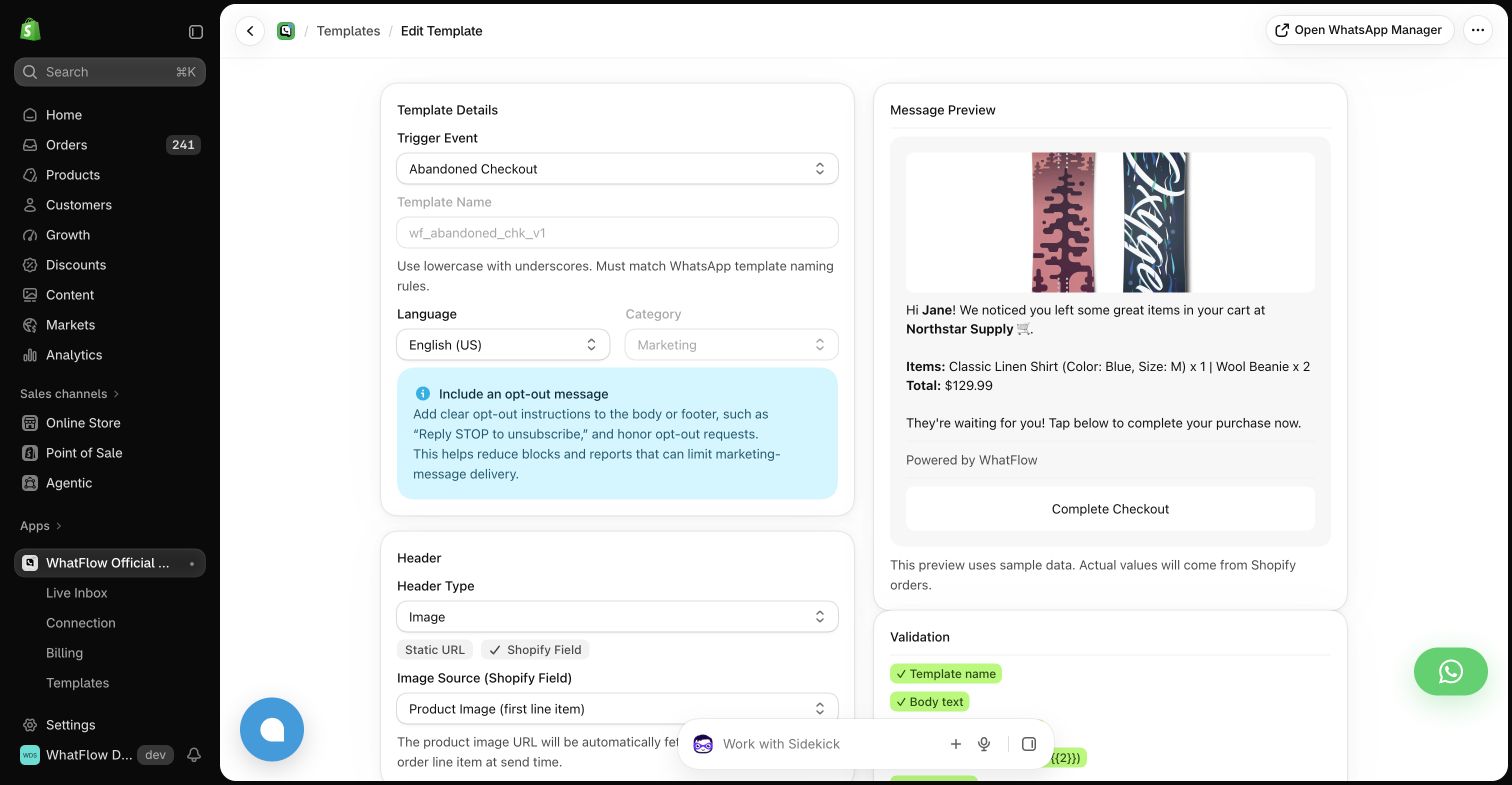
The WhatFlow demo app shows event automations within Shopify and a template editor with explicit field mappings. An operator can inspect a confirmation or checkout reminder without first building the surrounding application.
This is the application scope to compare against a Gupshup-based solution. If the latter includes a partner-built Shopify interface, compare that interface and its support arrangement directly. If it is a custom project, include engineering and maintenance in the estimate.
Name the owner of each failure
Imagine Shopify records an order, but the customer receives no notification. Who investigates the event? Who checks the message status? Who knows which template and recipient field were used? A good proposal should make those responsibilities clear before an incident occurs.
Use the same questions for an app and a platform implementation. The difference is not whether failures are possible; it is whether the business has a practical way to investigate and resolve them.
Keep AI scope specific
If conversational AI is part of the brief, choose a few store questions with clear expected behavior. Include an answer available in the policy and a case that requires a person. Ask how the knowledge is maintained and how an operator reviews the outcome.
Do not use a successful notification send as proof that an AI support deployment is ready. They have different acceptance criteria and deserve separate review.
A useful decision rule
Evaluate Gupshup when the breadth or customization of the project justifies a platform implementation. Test WhatFlow when the required Shopify workflow is close to an existing app's scope. In both cases, compare the working system, its owner and its total cost rather than the vendor name alone.
Questions worth asking
Is Gupshup only a Shopify notification product?
No. Its current product overview presents broader conversational AI and messaging capabilities for sales, marketing and support.
What should a platform proposal include?
The actual products, integration work, operator interface, support responsibilities, implementation effort and ongoing commercial terms.
Sources and methodology
We checked these primary sources on October 24, 2026. Vendor pages describe advertised capabilities, rather than independent performance tests. Confirm current pricing, plan limits and availability with each provider.
- Gupshup product overview
Primary source for the advertised Gupshup capabilities discussed above.
- WhatFlow Shopify App Store listing
Official app identity and current installation terms. WhatFlow workflow descriptions also reflect the demo-store configuration pictured in this guide.