
Publisher disclosure: this comparison is written by WhatFlow. Competitor capabilities are based on the linked public documentation; the WhatFlow screenshots come from our demo store. Examples are illustrative, and results depend on your store and configuration.
WhatFlow and Twilio at a glance
| Consideration | WhatFlow | Twilio |
|---|---|---|
| Build versus configure | Configure Shopify workflows in an existing application | Programmable WhatsApp messaging for a custom implementation |
| Source of this comparison | Observed Shopify demo configuration; test your required workflow before launch | Linked vendor product documentation; confirm plan and account availability |
| Cost check | Use current WhatFlow pricing and the Shopify installation terms for your expected usage | Request a current Twilio quote covering the required product, integration and message volume |
The API is only one part of the product
Sending a message through an API is a useful technical milestone. It is not yet a Shopify recovery workflow. The finished system also needs an event source, recipient matching, template variables, scheduling, error handling and a place for a person to investigate problems.
This is why WhatFlow versus Twilio is primarily a build-versus-configure decision. A developer platform and a configured store application can both be sensible choices, but they include different amounts of work.
What Twilio supplies
Twilio presents WhatsApp as a programmable messaging channel within its communications platform. That is relevant when a business wants to design its own application, connect custom systems or control behavior beyond a packaged store workflow.
Evaluate the exact APIs, account setup and commercial terms your architecture requires. Do not assume that selecting a messaging provider also selects the customer interface or the Shopify integration.
What WhatFlow already packages
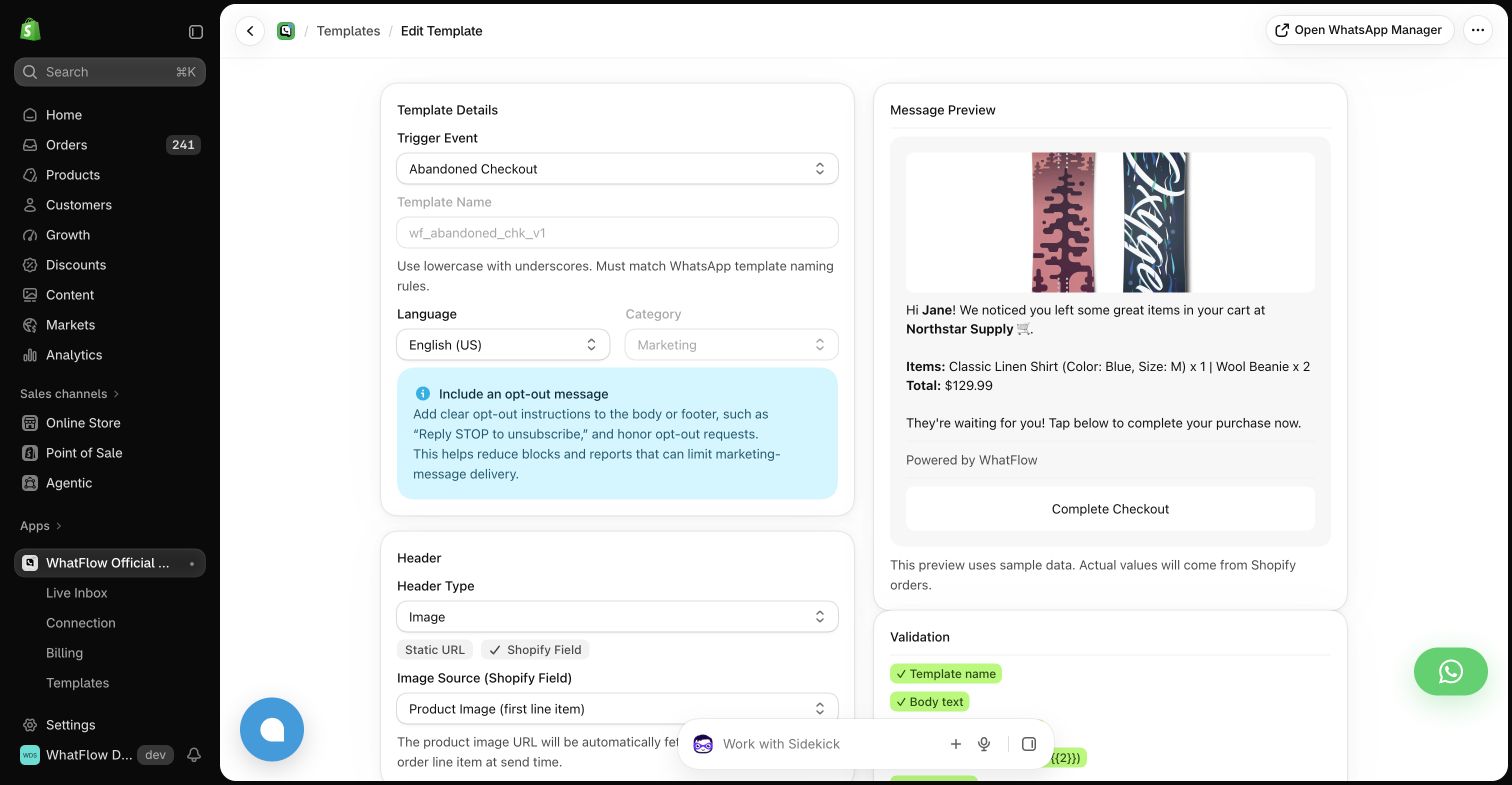
The WhatFlow demo app includes event-specific automation settings, a template editor and Shopify field mappings. An operator can inspect the body and recovery button without writing the application that joins those pieces together.
That is the value to assess in a packaged workflow. It is not a claim that a custom Twilio implementation cannot reproduce the behavior. The question is whether building and maintaining that behavior is a good use of your team's time.
Write a real build estimate
Include the first version and the work that follows it. Someone must maintain the Shopify integration, protect credentials, process repeated events safely, handle failed messages and update the operator interface. Someone also has to support the business when the original developer is unavailable.
Ask engineering to estimate a small production journey rather than a message-send proof of concept. A realistic estimate should name the owner of monitoring, incident response and future changes.
Test the failure path in either approach
For a custom build, ask what happens when the same event arrives twice or a request succeeds but the caller times out. For a configured app, ask how an operator sees failures and how the provider handles those situations. Do not send real campaigns as a way to discover the behavior.
Use controlled recipients and a test store. Track the event, the intended message and the observed outcome. That gives both a software buyer and an engineering team the same acceptance criteria.
Make the tradeoff explicit
Choose a Twilio-based project when the custom requirements justify owning the application. Evaluate WhatFlow when the Shopify workflow is already close to what the store needs. Compare total operating cost and responsibility over time; neither an API rate nor a monthly app price explains the whole decision.
Questions worth asking
Is Twilio the same kind of product as a Shopify WhatsApp app?
No. Twilio supplies programmable communications capabilities. A Shopify app packages a particular set of workflows and interfaces on top of a messaging connection.
When does a custom WhatsApp build make sense?
When requirements justify the engineering effort and the business has an owner for maintenance, monitoring, integration changes and customer-facing operations.
Sources and methodology
We checked these primary sources on October 24, 2026. Vendor pages describe advertised capabilities, rather than independent performance tests. Confirm current pricing, plan limits and availability with each provider.
- Twilio WhatsApp product overview
Primary source for the advertised Twilio capabilities discussed above.
- WhatFlow Shopify App Store listing
Official app identity and current installation terms. WhatFlow workflow descriptions also reflect the demo-store configuration pictured in this guide.