Write product FAQs around specific buying decisions that the page has not already answered. Start each response with the answer, include the condition that changes it and distinguish product specifications from store-wide policies. Use verified information, keep answers aligned with the rest of the page and provide a realistic help route for cases the FAQ cannot resolve.
Key takeaways
Choose questions with a concrete purchase decision behind them.
Answer directly and include the condition that matters.
Keep specifications and maintained policy references consistent.
A product FAQ is useful when it answers a question the main description has not resolved. It is less useful when it repeats the same promotional claims in question form. Start with what buyers actually ask about fit, use, compatibility and the buying process.
Keep the section selective. A shopper should be able to scan it and find a relevant answer without reading a second product description. The aim is clearer information for people, not a large block of repeated keywords disguised as a help section.
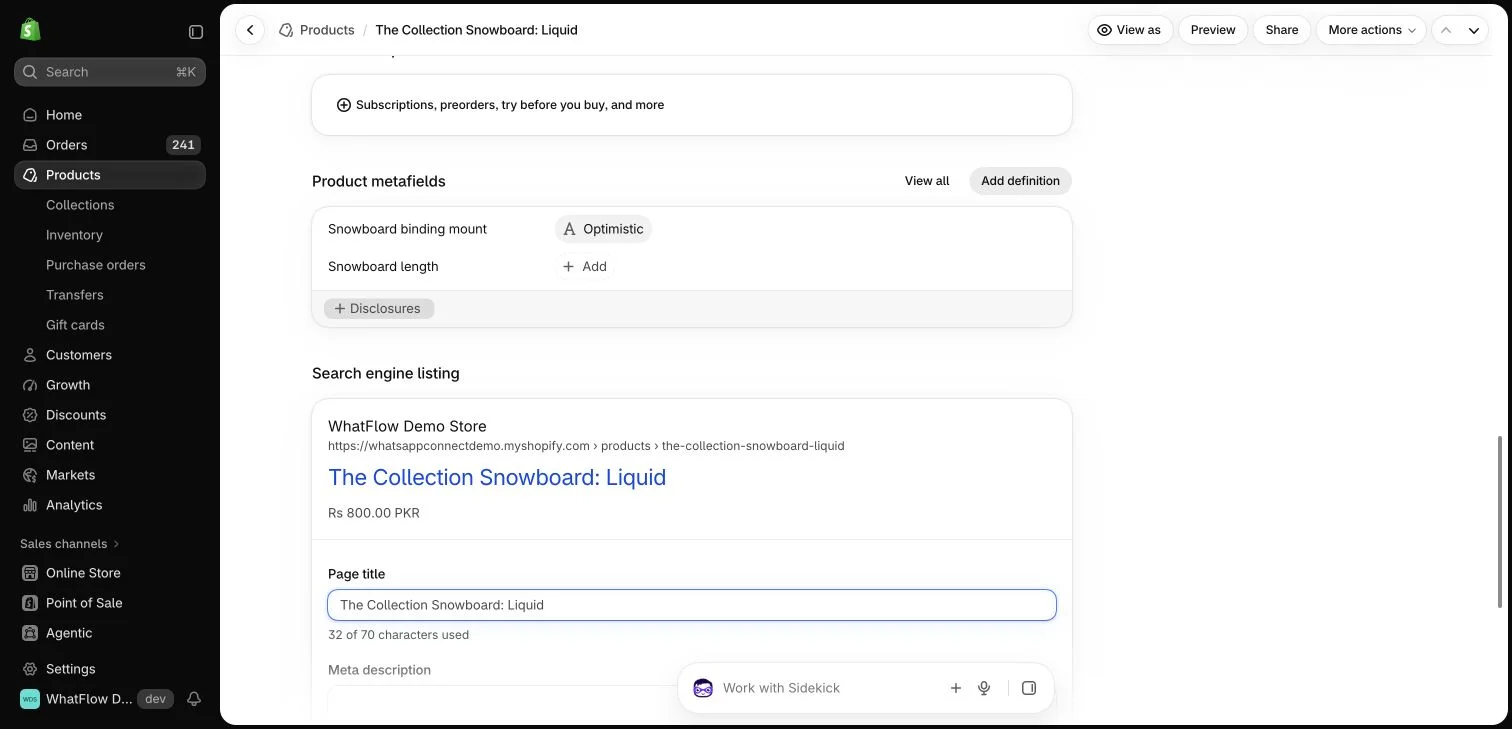
Shopify search-engine listing fields for a demo product. This editor preview does not demonstrate a Google ranking or rich result.
Separate product questions from store policies
A product-specific question concerns the item: dimensions, materials, care or compatibility. A store-level policy may apply across the catalog. Summarize the relevant policy accurately and link to the maintained source rather than copying a long policy into every product page.
This separation makes updates easier. If delivery conditions change, one central source should drive the correction. Repeated policy text across dozens of products can become inconsistent, leaving support colleagues to explain which version the customer should trust.
“What size laptop fits?” asks for a useful limit. “Why is our bag amazing?” asks the merchant to repeat a sales pitch. Prefer questions that help the visitor establish whether the product suits their situation.
Use the customer’s ordinary language, but do not publish identifiable support messages without an appropriate basis. Summarize the theme or write a hypothetical example. A recurring question is useful editorial input even when the original conversation must remain private.
Answer directly and include the important condition
Begin with the answer, then explain the limit. If a case changes device compatibility or a material needs particular care, include that detail. Avoid a reassuring “yes” followed much later by the qualification that determines whether the answer is actually useful.
Do not invent a universal recommendation when the product information is incomplete. Ask for a measurement or provide a support route for the exceptional case. Saying what you need to know is more helpful than presenting a guess as confident product advice.
The Google Search: creating helpful content guidance supports a people-first editorial approach; use it alongside the specific product evidence needed for your answer.
Keep the FAQ aligned with the rest of the page
Compare the answer with the specification, photographs, variant labels and saved support replies. A contradiction creates more uncertainty than an omitted answer. Assign an owner to resolve discrepancies rather than choosing whichever wording sounds more persuasive.
Reviews can reveal useful questions, but one customer’s experience does not establish a universal specification. Distinguish subjective feedback from the product details the store can substantiate. Keep both available in the places where they help the shopper interpret the item.
Provide a route for the remaining question
A good FAQ reduces repeated confusion without pretending to cover every situation. A clearly placed help entry point can let the visitor ask about an unusual device, sizing concern or intended use. Set realistic response expectations rather than promising instant expert advice at all times.
WhatFlow’s theme-fitting WhatsApp buttons and shared inbox can support that conversation. The FAQ should still answer the common question on the page. Requiring every buyer to start a chat for basic dimensions adds work for both the customer and the team.
Maintain usefulness rather than chasing markup alone
Review the section when product versions, policies or recurring questions change. Remove obsolete answers and add new ones only when they serve a distinct need. Keep a short record of significant changes so support and content colleagues stay aligned.
Do not promise that adding an FAQ guarantees a special search-result format or a ranking improvement. Google’s people-first guidance supports writing useful content, but the practical test is whether a reader can make a better-informed decision. A concise, accurate answer earns its place without that promise.
Turn a vague FAQ into a decision answer
For a hypothetical laptop bag, replace “Is this a great bag for work?” with “Will my laptop fit if it stays in a protective case?” The answer needs verified internal dimensions and a clear comparison method, not a promise based solely on screen size. Explain which measurements the shopper should check and what allowance matters if the product specification supports it. If the measurement is unavailable, get it confirmed before publishing a confident answer.
Check that the same limit appears consistently in the size guide, product description and saved support reply. Keep a store-wide return policy in its maintained location, with a concise relevant summary rather than a full duplicate. Review recurring questions after the FAQ change: a new unusual device question may still deserve a WhatFlow conversation, while repeated requests for the same measurement suggest the answer is missing, hard to find or too ambiguous to use.
Before you put this into practice
Confirm the evidence behind each answer.
Remove duplicate promotional questions.
Check related saved replies after a product change.
Explore WhatFlow Business API for WhatsApp messaging and a team inbox with no seat fees. Features are included across plans, including Free; message allowances and rates differ.
Safwan Adnan is co-founder and CEO of WhatFlow. This guide is published by WhatFlow and includes its product where relevant. Worked examples are illustrative unless a caption identifies an actual demo-store configuration; they are not merchant performance results.