Budget WhatsApp messaging by estimating the full journey’s sends, separating applicable app and messaging charges and dividing total relevant cost by a clearly defined useful outcome. Include follow-ups, recipient markets, support work and other required tools. WhatFlow Business API has no inbox seat fees and includes all features across plans, while message allowances and rates differ.
Key takeaways
Count follow-ups and stopping behavior in the volume forecast.
Separate applicable costs and avoid double-counting allowances.
Label attributed outcomes separately from incremental profit.
A low monthly subscription can still produce an expensive messaging program if the volume assumptions are wrong. A larger plan can also be poor value when most included capacity goes unused. Build the comparison around your store’s likely workload and the outcome you are trying to achieve.
Separate predictable platform charges from charges that vary by recipient, message type or usage. Then make the assumptions visible. A budget that a colleague can update is more useful than a single attractive figure copied from a pricing headline.
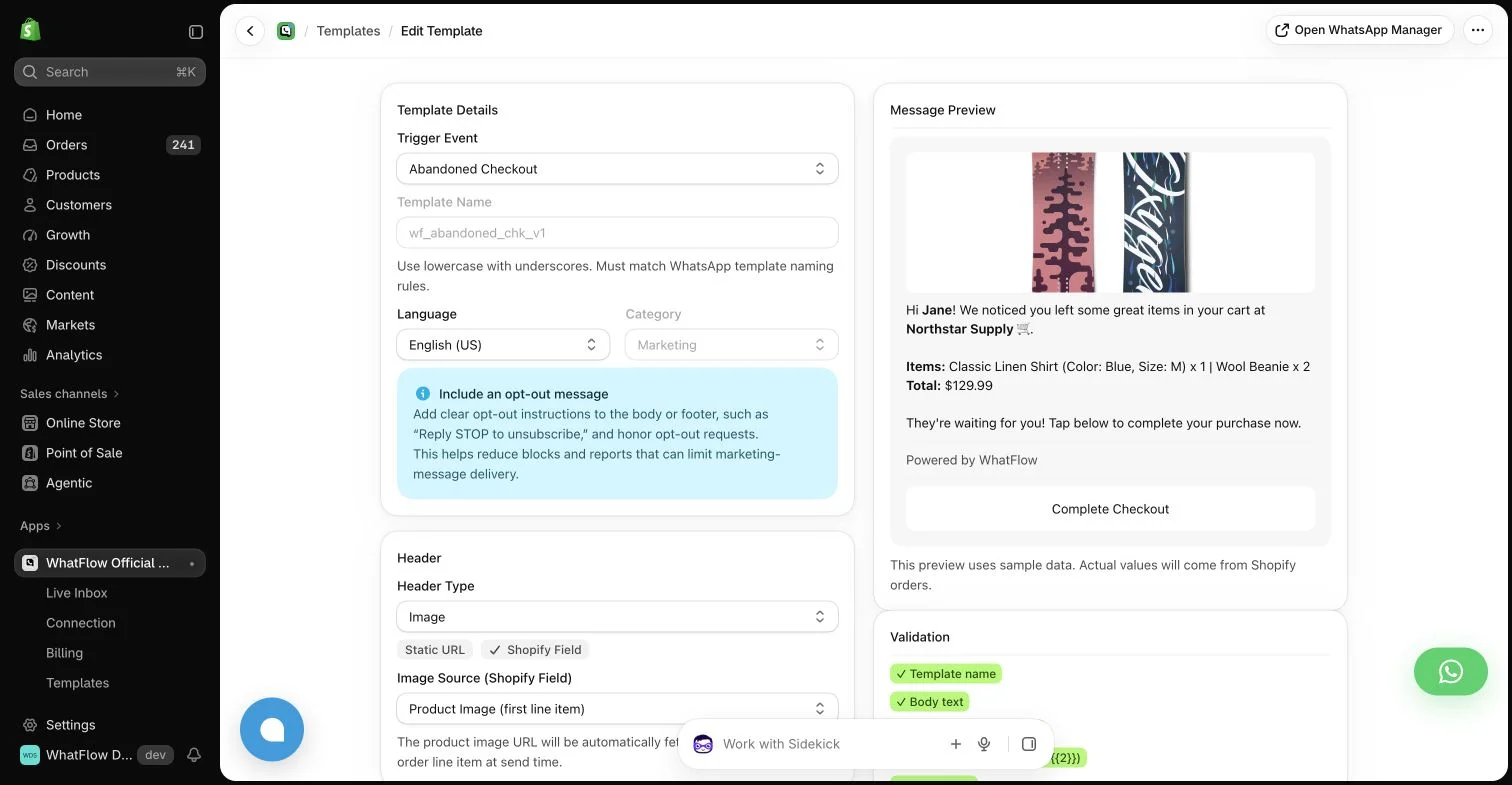
WhatFlow template editor in the demo store. Sample message data illustrates configuration, not a completed send or measured campaign outcome.
Count the messages the journey actually sends
Start with eligible recipients and the number of planned contacts per person. Include reminders and relevant follow-ups rather than counting only the first campaign message. A flow triggered by multiple fulfillments can also send more than one update for a single order.
Record what stops the sequence. A completed purchase, reply or opt-out may change the number of later messages where the configured workflow supports it. Do not budget around perfect suppression unless the required data and rules are actually connected.
List the app subscription, included allowances, overage or message rates and applicable WhatsApp charges. Add charges from other tools needed for the same journey. The provider’s current billing model determines which items apply; do not assume every app combines them in the same way.
Meta pricing can depend on the message category and recipient market under its current rules. Check the official pricing information and the provider’s treatment of those charges. A quoted country-specific example should not be presented as a universal cost for every recipient.
Include the team model in the comparison
Some messaging products charge for inbox users or reserve certain capabilities for higher plans. Check the actual terms rather than assuming that a cheap entry plan supports the whole team. A feature missing from the required tier can change the real monthly decision.
WhatFlow Business API includes features across its plans and does not charge inbox seat fees. Plans differ by messaging allowances and rates. That can make team participation easier to budget, while still leaving the message volume and applicable delivery charges to be evaluated honestly.
Include the Shopify app cost audit when comparing subscriptions, feature access and inbox-user charges.
Check WhatsApp Platform pricing for the applicable recipient-market and message-category charges before comparing the forecast with actual billing.
Use scenarios rather than one perfect forecast
Model a normal month, a quiet month and a peak period. Keep the same definitions across providers so the comparison reflects the same workload. A plan that fits a promotional spike may be unnecessary for most of the year, depending on how the provider allows changes.
Use explicit assumptions about follow-up volume and recipient markets. Do not fill missing information with a claim that all messages are the cheapest category. If the budget depends heavily on one uncertain assumption, identify that uncertainty before committing to the larger campaign.
Connect cost to a useful result
For support, a useful outcome might be a resolved conversation measured under a consistent definition. For a campaign, it might be an attributed purchase evaluated after relevant margin and discount costs. Avoid mixing these outcomes into one number that obscures the purpose of the messages.
Attribution is not the same as incrementality. A purchase connected to a message may have happened anyway. When the store can run a suitable comparison, use it to learn more. Otherwise describe the result as attributed and keep the limitation visible.
Update the model from actual billing
Compare the first invoice with the forecast and investigate the largest differences. Check message counts, reminders, recipient mix and any additional tools used. A small controlled pilot can reveal a configuration mistake before it is repeated across a much larger audience.
The cheapest useful program is not necessarily the one with the lowest headline subscription. It is the one that performs a relevant task, reaches the right people and produces a result worth its total cost. Keep the model simple enough to revisit whenever the workload changes.
Build a budget that exposes the uncertain assumptions
In a hypothetical planning example, 200 eligible recipients receive one initial message and 60 receive a follow-up, producing 260 planned sends before other applicable interactions. Those are example volumes, not expected behavior. Price the relevant sends using the actual category, recipient market and provider billing treatment; do not multiply everything by an assumed universal rate. Add the subscription and any other required tool cost without double-counting included allowances.
If the program costs 80 currency units and records 16 attributed purchases under a stated window, its example cost per attributed purchase is 5 units. That calculation does not establish incremental profit: some buyers may have purchased anyway, and product margin, discounts, returns and staff work remain relevant. Repeat the model for quieter and busier volumes. After a controlled pilot, compare the invoice and actual send counts with the assumptions before committing to a larger audience.
Explore WhatFlow Business API for WhatsApp messaging and a team inbox with no seat fees. Features are included across plans, including Free; message allowances and rates differ.
Safwan Adnan is co-founder and CEO of WhatFlow. This guide is published by WhatFlow and includes its product where relevant. Worked examples are illustrative unless a caption identifies an actual demo-store configuration; they are not merchant performance results.