Coordinate email, SMS and WhatsApp by mapping every message around the same customer event, assigning each channel a useful job and defining shared exits where supported. Check preferences and purchase status before follow-ups. Review the combined timeline from the buyer’s perspective, because sensible sequences in separate apps can still create duplicate or contradictory contact.
Assign one system to each reminder decision and exit.
Review total customer contact rather than channel dashboards alone.
A store can send a modest number of messages from each app and still overwhelm the customer. An email reminder in the morning, an SMS at lunch and a WhatsApp offer that evening may all come from the same underlying event. The buyer experiences one brand, not three separate campaign calendars.
Channel coordination starts with the complete sequence. List what is sent, why it is sent and which system owns the decision. Then make the journey coherent before debating which channel has the most attractive headline engagement figure.
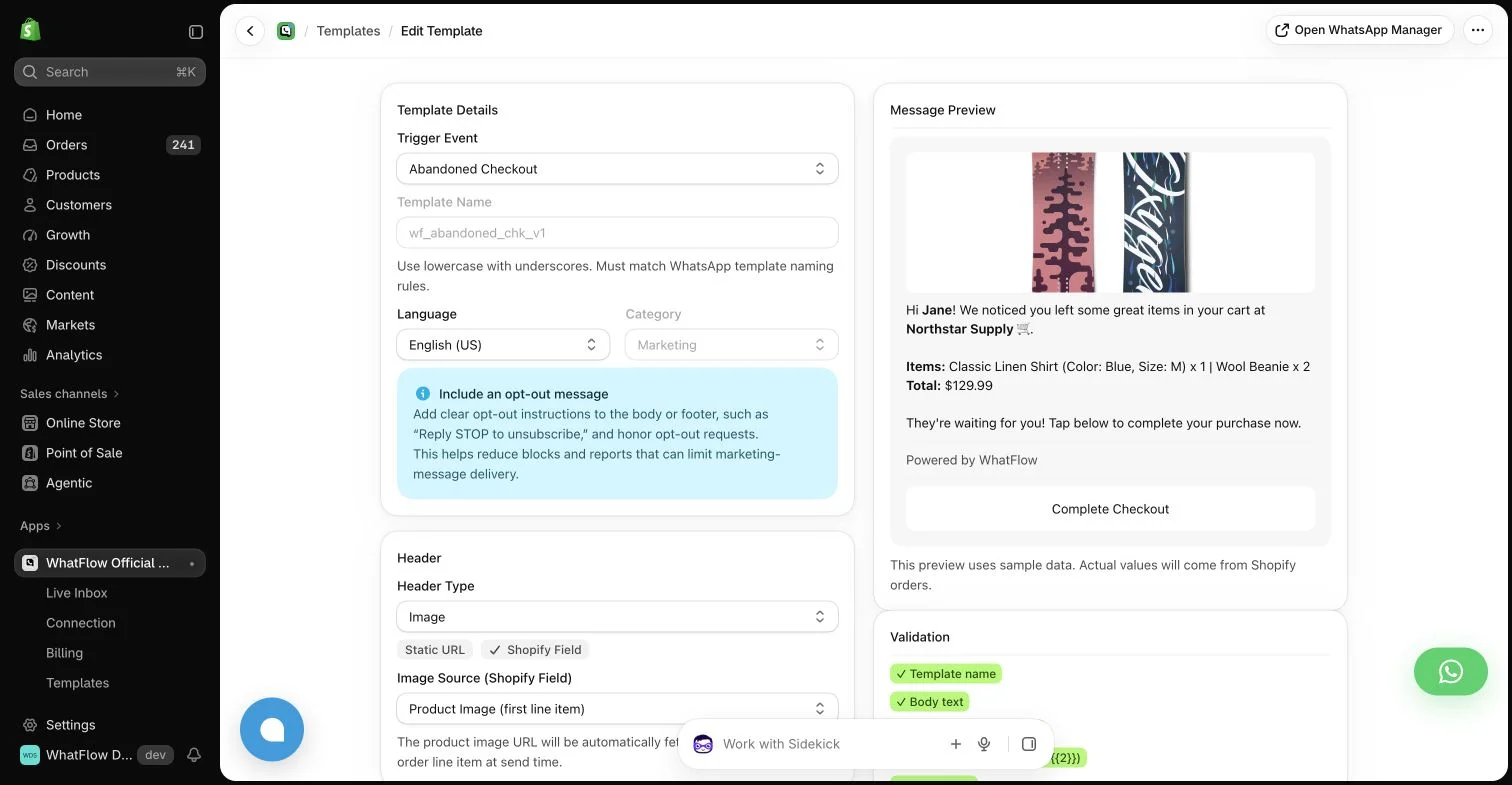
WhatFlow template editor in the demo store. Sample message data illustrates configuration, not a completed send or measured campaign outcome.
Give each channel a job
Email can carry longer explanations and a browsable product selection. SMS can support concise notices where appropriate. WhatsApp can make a permitted conversation convenient when the buyer needs to reply, ask a question or choose a next step. None of those roles makes one channel universally better for every customer.
Choose the channel around the task and the customer’s preferences. A detailed setup guide may be easier to revisit on a page or in email, while a short support exchange can fit a conversation. The content and available permissions should guide the choice.
Map messages by customer event
Create one view of the messages triggered by checkout, fulfillment, review collection and repeat-purchase campaigns. Include built-in store notifications as well as app automations. Note delays and conditions so the team can see where contacts overlap.
Test the combined journey with controlled data. An app dashboard showing a sensible sequence does not reveal the messages sent by another app. Pay attention to split shipments, late replies and a purchase completed between two scheduled follow-ups.
A preference on one channel is not automatically a preference on every channel unless your connected systems and policy establish that relationship. Know how each tool records opt-outs and how the team should respond when a customer makes a broader request.
Do not move a person to another channel simply to continue the same unwanted campaign. Check the applicable requirements and the customer’s actual choice. WhatsApp’s messaging rules, templates and customer-service window remain relevant even if email is the primary campaign channel.
Decide which system checks whether a purchase or other goal has already happened. Define how later reminders stop where supported data is available. A customer should not receive “finish your order” messages from one tool while another is already sending the order confirmation.
When the tools cannot share a needed status, simplify the sequence rather than pretending the coordination is complete. A clear manual review or a narrower campaign can be safer for the experience than several loosely connected automations competing to claim the same outcome.
Keep replies connected to the right team
A marketing message can generate a support reply. Prepare the receiving team with the campaign context and the actual offer conditions. Do not ask the buyer to explain a promotion that the store itself sent them.
WhatFlow Business API provides WhatsApp messaging and a team inbox without seat fees. That can help the team handle the conversational part of the journey. Other apps still own their channels, and the integration between them depends on supported tasks and available data.
Compare value using consistent definitions
Measure costs, useful responses and commercial outcomes under clearly described attribution rules. A channel reporting a higher open or click rate is not automatically producing more incremental profit. Delivery, audience, creative and the purpose of the message can all differ.
Review opt-outs and customer complaints alongside attributed orders. The most effective next change may be removing a duplicate reminder rather than adding a new channel. A coordinated program should feel like a useful relationship from the customer’s side, even though several systems support it behind the scenes.
Reconstruct one checkout across all channels
Hypothetical example: a shopper receives a recovery email, completes checkout and later receives a scheduled WhatsApp reminder. Put the email send, purchase event, order confirmation and WhatsApp send on one timeline. Check which system knew about the purchase and when. That makes the failure actionable: the problem may be an unavailable exit signal rather than the reminder’s wording.
Choose one owner for the next recovery step and verify that it can check the purchase state at the required moment. If the tools cannot support that coordination, simplify the sequence. Keep channel preferences alongside the timeline, and make broad stop requests visible to the responsible team. WhatFlow Business API can handle WhatsApp replies without adding inbox seat fees as another colleague investigates.
Before you put this into practice
List every message for one event across all tools.
Test a purchase occurring between two reminders.
Assign ownership of broad stop requests and unresolved overlaps.
Explore WhatFlow Business API for WhatsApp messaging and a team inbox with no seat fees. Features are included across plans, including Free; message allowances and rates differ.
Safwan Adnan is co-founder and CEO of WhatFlow. This guide is published by WhatFlow and includes its product where relevant. Worked examples are illustrative unless a caption identifies an actual demo-store configuration; they are not merchant performance results.
No channel is best for every task. Consider conversation needs, content length, audience preferences, permissions and total cost.
Should a purchase stop checkout reminders across channels?
Define that exit wherever the connected data supports it, and test the combined sequence so completed buyers are not repeatedly asked to finish the same order.