A repeat-purchase campaign should offer a plausible next benefit, such as a compatible refill, accessory or useful product guidance. Choose a defined audience and testable timing rule, exclude buyers whose need is already met where supported, and prepare for replies. Evaluate purchases after messaging and promotional costs rather than using a discount or click count as the whole strategy.
Key takeaways
Start with a next need that fits the original purchase.
Use supported exclusions and a testable timing assumption.
Evaluate value after costs rather than discount response alone.
A customer buying once gives you useful context, not a permanent reason to send offers. A good repeat-purchase campaign starts with a plausible next need. That might be replenishment, an accessory that fits the original item or advice that helps the customer get more value from what they already own.
A discount can support a campaign, but it should not be the only reason the message exists. If the recommendation is irrelevant, a lower price may simply make the store’s next interruption cheaper rather than more useful.
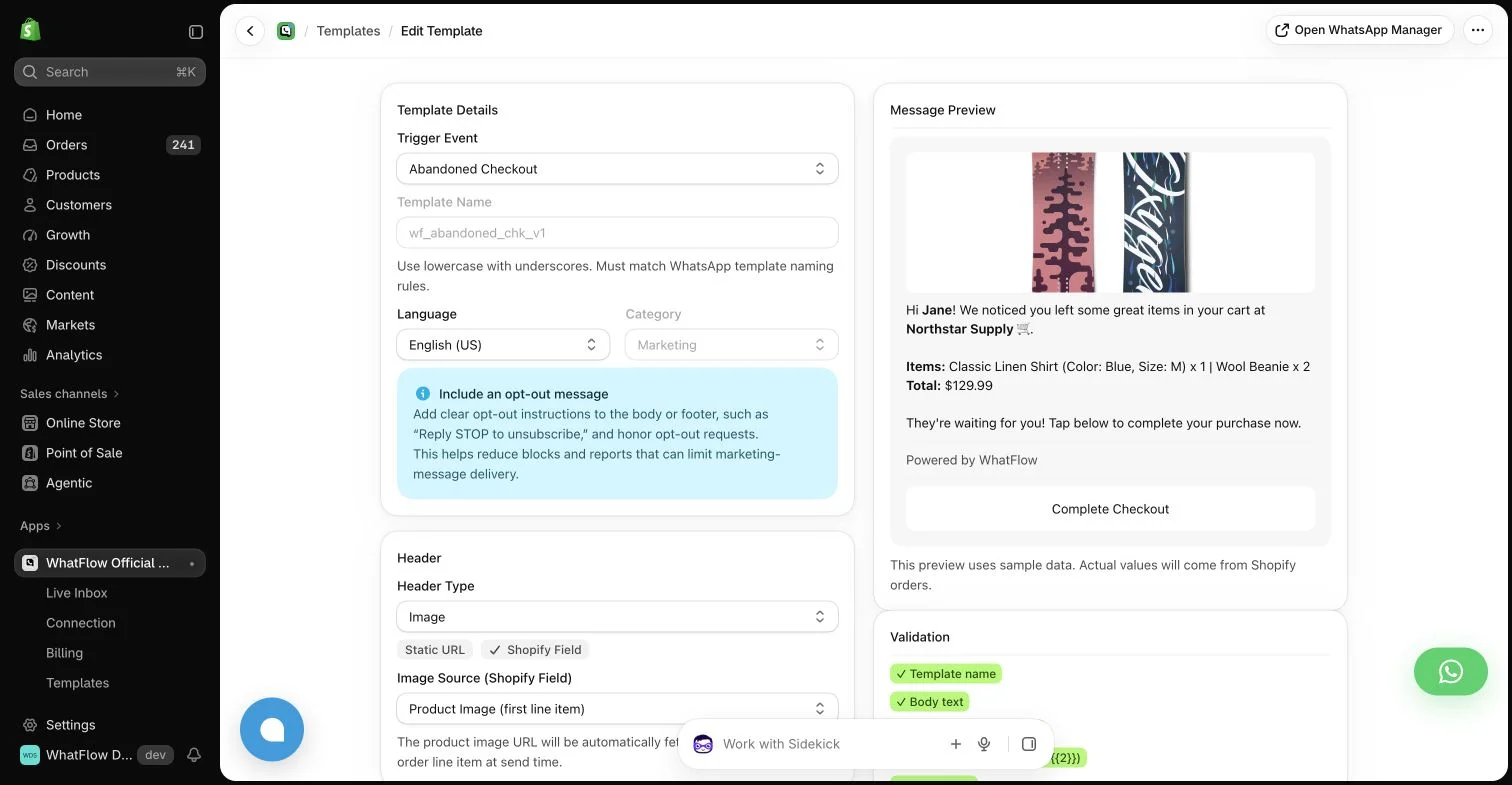
WhatFlow template editor in the demo store. Sample message data illustrates configuration, not a completed send or measured campaign outcome.
Choose a customer need you can explain
Write one sentence describing why this group might want the next product. A buyer of a refillable dispenser may eventually need refills. A buyer of a durable dining table probably does not need another table next week. The original purchase should inform the hypothesis without becoming a claim about the customer’s private circumstances.
Check product compatibility and availability before creating the audience. A generic accessory recommendation is frustrating if it does not fit the version the customer bought. When the data cannot establish compatibility, use broader guidance or ask a question rather than implying certainty.
Estimate the likely use cycle from product knowledge and observed store behavior. Do not present the estimate as a fact about every buyer. A household buying in bulk may replenish differently from someone trying the product for the first time.
Start with a manageable group and one timing rule. Record the hypothesis, dates and relevant product conditions. If the response is mostly “I still have plenty,” the campaign may be early. A result like that is useful feedback even if the immediate purchase count is low.
Exclude customers for clear operational reasons
Check whether the item has already been reordered, whether there is an unresolved issue and whether the customer has opted out of the channel. Use supported data and a clear policy. Do not claim a perfect exclusion process if the relevant status is not connected to the campaign tool.
Suppression is especially important when several apps can send a similar offer. Decide which system owns the audience and how a new purchase updates eligibility. A buyer should not receive a reminder to reorder moments after paying for the same product.
Use the WhatsApp Business messaging policy to check applicable messaging permission and channel requirements; a relevant message still needs the appropriate sending process.
Write a message that acknowledges the relationship
Recognize the product context without becoming overly familiar. A useful draft might explain that refills are available and offer help choosing the correct option. Avoid invented urgency or language implying that the business knows the customer has run out.
For WhatsApp, use the appropriate approved format and recipient permissions. A previous service conversation does not automatically make a later promotional campaign unrestricted. WhatFlow can support the messaging and replies, while the merchant remains responsible for the audience and the underlying commercial claim.
Customers may ask whether the formula changed, whether an accessory fits or whether a subscription is available. Prepare accurate answers and decide who handles exceptions. A campaign that invites replies but leaves them unanswered creates work for the customer without a dependable outcome.
WhatFlow’s team inbox has no seat fees on Business API plans, which can help a small store involve the right colleague. The inbox still needs ownership and sensible response expectations. A shared tool does not decide which person has the product knowledge to answer a specific question.
Measure value after the discount and message cost
Evaluate attributed purchases alongside product margin, promotional cost, delivery charges and subsequent returns. Keep the attribution window visible and avoid claiming that every connected order was caused by the message. A suitable holdout can help evaluate incremental effect when the store has the tools and volume.
The best next iteration may be a narrower audience or clearer product explanation rather than a larger discount. A repeat-purchase program should become more relevant as the store learns. The aim is a customer who sees a timely reason to return, not someone trained to wait for the next coupon.
Write the relevance case before the offer
For a hypothetical store selling refillable soap dispensers, write the campaign reason as “help owners find a compatible refill.” List the dispenser versions that the refill supports, the eligible purchase dates and the exclusions you can actually verify. If a customer already reordered or has an unresolved leak complaint, decide how the process handles that record before building the audience. The original purchase informs relevance; it does not prove the household has run out.
Begin with a message explaining the refill and offering help with compatibility, without adding a coupon merely to create urgency. Record replies about timing, stock and suitability alongside attributed orders. If many people say they still have plenty, adjust the timing hypothesis before lowering the price. If buyers cannot identify the correct refill, improve the destination. WhatFlow’s shared inbox can support these conversations, while the decision to expand should reflect the value after message charges and support work.
Before you put this into practice
Verify compatibility before choosing the audience.
Explore WhatFlow Business API for WhatsApp messaging and a team inbox with no seat fees. Features are included across plans, including Free; message allowances and rates differ.
Safwan Adnan is co-founder and CEO of WhatFlow. This guide is published by WhatFlow and includes its product where relevant. Worked examples are illustrative unless a caption identifies an actual demo-store configuration; they are not merchant performance results.