Prepare Shopify support for Black Friday by documenting the offer, confirming stock and delivery information, assigning conversation owners and rehearsing likely exceptions. Give colleagues one current reference and a clear escalation route. Review campaign replies alongside order notifications so the team can answer accurately and keep unresolved cases visible throughout the sale.
Key takeaways
Publish one current reference for offer terms and delivery estimates.
Name the owner of new messages and each escalation.
Rehearse exceptions before campaign volume increases.
A busy sale changes support before the first order arrives. More visitors ask about eligibility, delivery and stock; returning customers ask whether an offer applies to something they bought earlier. If the team learns the campaign details from customer screenshots, the support process is already behind.
Prepare the information and ownership before increasing message volume. The objective is not to answer every question with an automated promotion. It is to give customers accurate help while keeping exceptional cases visible during a period when several colleagues may share the workload.
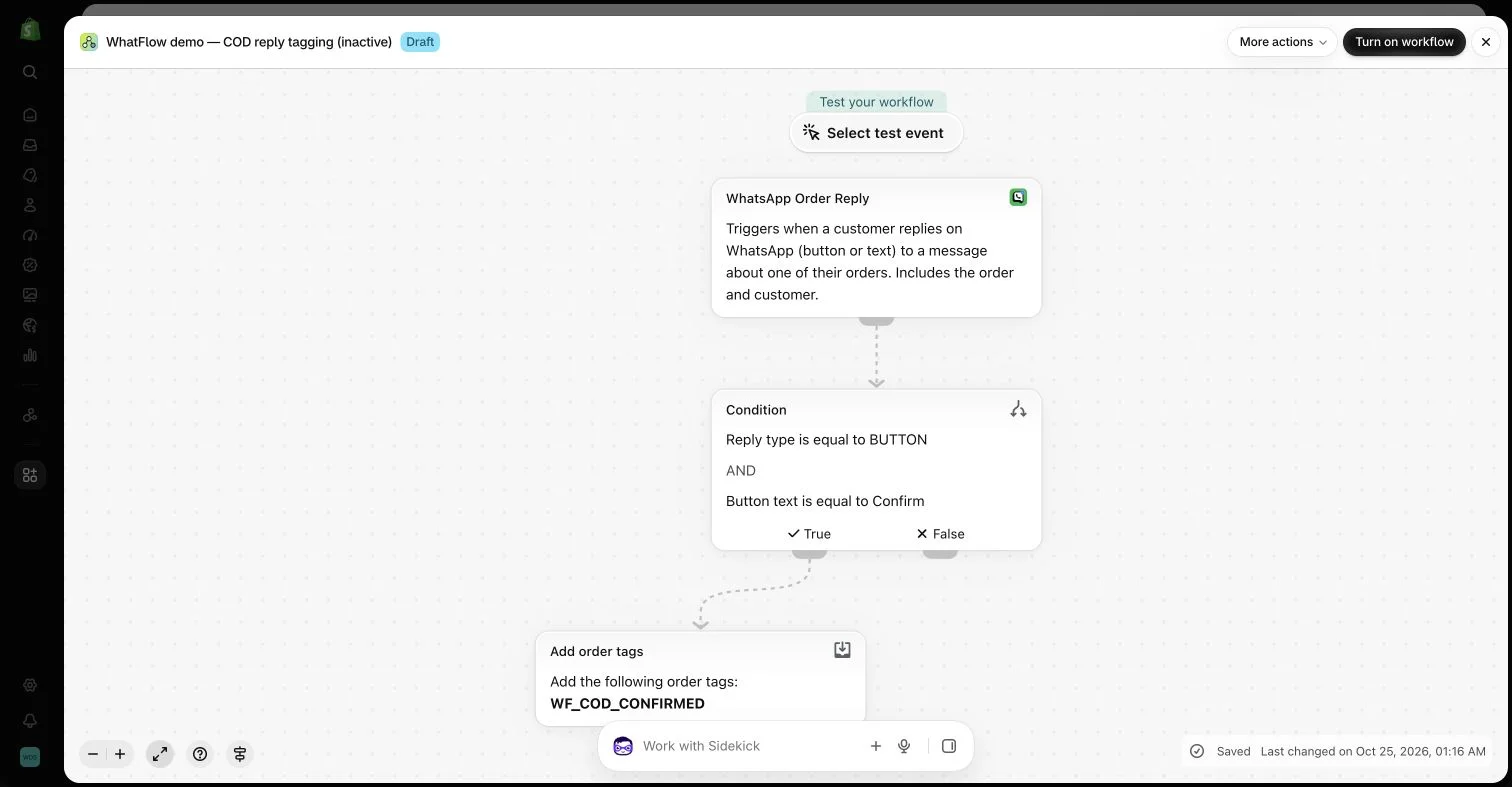
An inactive workflow in the WhatFlow demo store illustrates order-reply configuration. No customer messages or order changes were made.
Give the team one current offer reference
Document the sale dates, eligible products, exclusions and how discounts interact. Include the actual destination links and the person who can resolve an unclear edge case. Update the reference when the campaign changes rather than circulating several competing versions.
Avoid vague statements such as “everything is discounted” when the checkout contains exceptions. Support should be able to explain the offer from the same source used by marketing. A concise, accurate summary can prevent many avoidable back-and-forth conversations.
Make sure product availability and expected processing information are current where the team answers questions. A peak-period promise should reflect the store’s actual capacity rather than a normal-week estimate copied into campaign creative.
Distinguish the store’s processing time from the carrier journey. If a date is an estimate, describe it that way. Do not claim that every order will arrive before an occasion unless the store can genuinely support the promise under the stated conditions.
Decide how new conversations are handled
Set a clear rotation or owner for incoming messages during the sale. Identify when another colleague takes over and how unresolved cases are handed off. A shared inbox is useful, but it does not automatically establish responsibility.
WhatFlow Business API has no inbox seat fees, which can make involving extra colleagues easier to budget. Use the supported access model appropriately and give each person the information they need. Do not treat broader access as a substitute for training or a clear escalation route.
Use a clear process for shared inbox ownership before adding more colleagues to the sale shift.
Use the WhatsApp Business messaging policy to check applicable messaging permission and channel requirements; a relevant message still needs the appropriate sending process.
Prepare a small set of adaptable answers
Write concise responses for common offer, sizing, delivery and return questions. Mark which values require a current check. Avoid saved replies claiming that an order shipped or a refund was issued unless the relevant action actually happened.
Keep the tone suitable for the situation. A customer reporting a failed checkout needs practical help, not another enthusiastic paragraph about the sale. Colleagues should be able to adapt the wording while preserving accurate information.
Coordinate promotional and operational messages
Review the email, SMS and WhatsApp campaigns together with order notifications. A customer completing a purchase should not continue receiving contradictory recovery messages where the connected systems can suppress them. Check combined contact volume, not only each app’s calendar.
For WhatsApp, apply the appropriate permissions and message formats. Approved templates and the customer-service window remain relevant during a busy promotion. Higher volume does not remove those requirements or make every stored phone number an appropriate campaign recipient.
Review the first busy period and adjust
Look at unresolved cases, recurring questions and workload by time of day. A sudden volume increase may come from an unclear offer rather than genuine demand for one-to-one advice. Improve the public information when several customers need the same explanation.
After the sale, capture the operational lessons while they are fresh. Keep the useful replies, correct the misleading pages and retire expired offers. The next peak period should begin with a better process, not a larger collection of old campaign screenshots.
Rehearse three difficult sale conversations
Before launch, run a short tabletop rehearsal using fictional customers. One asks whether a bundle qualifies for the discount, one wants a delivery date the store cannot guarantee, and one has already purchased but receives a recovery reminder. Ask the colleague on duty to find the answer, identify the authoritative record and state the next step. Time the lookup if useful, but treat it as a local process check rather than a response-time target.
Record each failure as an information gap, a missing decision owner or a broken connection between systems. For example, if two colleagues give different bundle answers, correct the offer reference before rewriting the saved reply. If the purchase suppression cannot be verified, adjust the reminder plan. Repeat only the failed cases with the next shift; a revised document is useful when another person can actually apply it.
Before you put this into practice
Run a fictional discount-exclusion question.
Check the handover for an unresolved delivery case.
Verify purchase suppression using controlled records.
Explore WhatFlow Business API for WhatsApp messaging and a team inbox with no seat fees. Features are included across plans, including Free; message allowances and rates differ.
Safwan Adnan is co-founder and CEO of WhatFlow. This guide is published by WhatFlow and includes its product where relevant. Worked examples are illustrative unless a caption identifies an actual demo-store configuration; they are not merchant performance results.