Reuse a customer review on social media only when the context, meaning and appropriate rights support the intended placement. Keep the product association clear, preserve important qualifications and inspect images for private details. Direct viewers to a relevant destination and evaluate reach, visits and questions separately from any attributed purchases or claimed conversion effect.
Key takeaways
Preserve the qualification that changes the review’s meaning.
Check appropriate rights for the specific placement.
Keep destination and product version aligned.
A useful review can help someone who has not reached the product page yet. It might explain a real use case, answer a common concern or show the item in ordinary life. Moving the review to social media should preserve that meaning rather than turn it into a broader claim the customer never made.
Start with the audience question and the intended placement. An organic post, an advertisement and a product image can have different practical requirements. Establish the appropriate rights and permission for the use rather than assuming that public visibility makes any reuse acceptable.
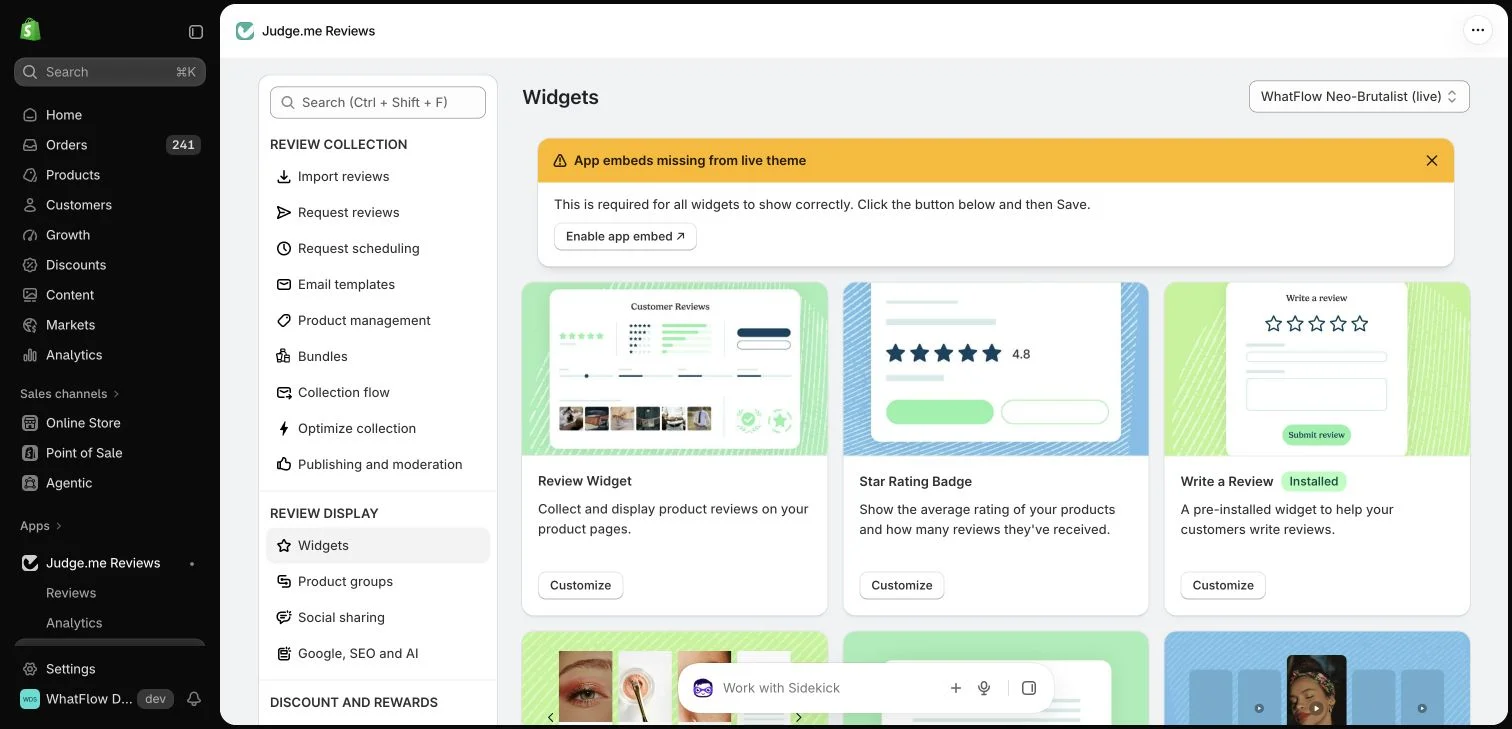
Judge.me widget configuration in the WhatFlow demo store. This setup view has no live theme embed enabled; ratings in the widget cards are interface examples.
Choose feedback that answers a real question
Look for a specific experience related to the product being discussed. A comment explaining capacity, fit or everyday use can be more informative than a short declaration that the store is amazing. Keep the product association visible where it affects interpretation.
Do not use a store-level service review as though it proves a technical property of one item. A customer praising delivery speed does not substantiate a durability or performance claim. The social post should make the source and subject understandable.
A short excerpt should not reverse a qualification or remove the part that changes the conclusion. If the full review contains both praise and a relevant limitation, consider whether the proposed excerpt remains fair. Do not join separate sentences into a new statement the reviewer did not write.
Keep the original submission accessible in the appropriate system so the team can verify the context. Any correction or approval process should follow the provider’s supported approach. Review text and media belong to their authors.
Match the asset to the placement
A square social image and a vertical story require different presentation, but readability matters in both. Use clear text and an appropriate amount of content. A tiny paragraph squeezed into a branded graphic is not useful simply because it contains five stars.
Label illustrations and hypothetical examples honestly. If a visual is an actual customer submission, preserve the relevant attribution and context. Do not create a fabricated customer screenshot or profile to make the post appear more authentic.
Inspect faces, address labels, documents and private details in the background before reuse. A photograph originally submitted to a review form may expose more when enlarged or distributed to a wider audience. Choose another asset or obtain an appropriate approved version when needed.
Do not assume a private support attachment is cleared for public marketing. WhatFlow can receive media in a WhatsApp conversation, but receiving the file does not turn it into a public testimonial or grant broad usage rights.
Link the post to the product or guide that completes the viewer’s next decision. If the testimonial concerns a specific version, make sure the destination still represents it accurately. An old post should not silently become evidence for a substantially changed product.
Prepare the team for questions generated by the post. WhatFlow’s inbox can support an appropriate WhatsApp conversation, and its no-seat-fee model can help colleagues participate. The team still needs accurate product information and a realistic support promise.
Evaluate the post without inventing a result
Track available reach, visits, questions and attributed purchases under consistent definitions. A popular review post does not prove a conversion uplift by itself. Keep paid distribution costs and any other campaign changes visible when assessing the result.
The strongest use of customer feedback helps a new reader understand something real. Respecting context and ownership is part of that usefulness. A review should remain credible after it leaves the original widget, not merely become another persuasive-looking graphic.
Keep a small approval record for each reused asset
For a fictional lunch-bag campaign, suppose a review says the bag holds a small container but not a tall bottle. A crop reading only “holds a container” may omit the detail another shopper needs. Keep the relevant limitation or choose a different excerpt. Record the original submission reference, exact approved text, product version, intended placement and the permission basis your team has checked before designing the post.
Review the final graphic at ordinary phone size, including any photo background, names and visible labels. Match the destination to the same product version and prepare answers to likely capacity questions. If an organic asset later becomes a paid advertisement, revisit the approved scope instead of assuming the original check covers every use. Report visits and product questions under consistent definitions; a widely shared review image can be useful without proving that it caused additional orders.
Before you put this into practice
Store the original review reference.
Inspect image backgrounds and attribution.
Recheck the scope before using an asset in advertising.
Explore WhatFlow Business API for WhatsApp messaging and a team inbox with no seat fees. Features are included across plans, including Free; message allowances and rates differ.
Safwan Adnan is co-founder and CEO of WhatFlow. This guide is published by WhatFlow and includes its product where relevant. Worked examples are illustrative unless a caption identifies an actual demo-store configuration; they are not merchant performance results.