Measure review collection rate with a stated numerator, denominator and response window. For example, divide attributed submissions from a completed invitation cohort by requests sent to that cohort. Keep eligible orders, sends, form visits and published reviews separate, and disclose attribution gaps between channels. Compare completed cohorts rather than treating yesterday’s invitations as finished evidence.
Key takeaways
Write the numerator, denominator and response window beside the rate.
Separate request coverage from submission and publication measures.
Compare completed cohorts and disclose channel attribution gaps.
A review dashboard can show a lower percentage even while a store collects more useful feedback. The difference may come from a larger denominator, a new channel or a delay between the invitation and the submission. Before changing the process, establish what the number actually measures.
Review collection rate is useful when the team agrees on its definition. It becomes misleading when eligible orders, requests sent and published reviews are treated as interchangeable stages. Write the calculation next to the report so a colleague can reproduce it.
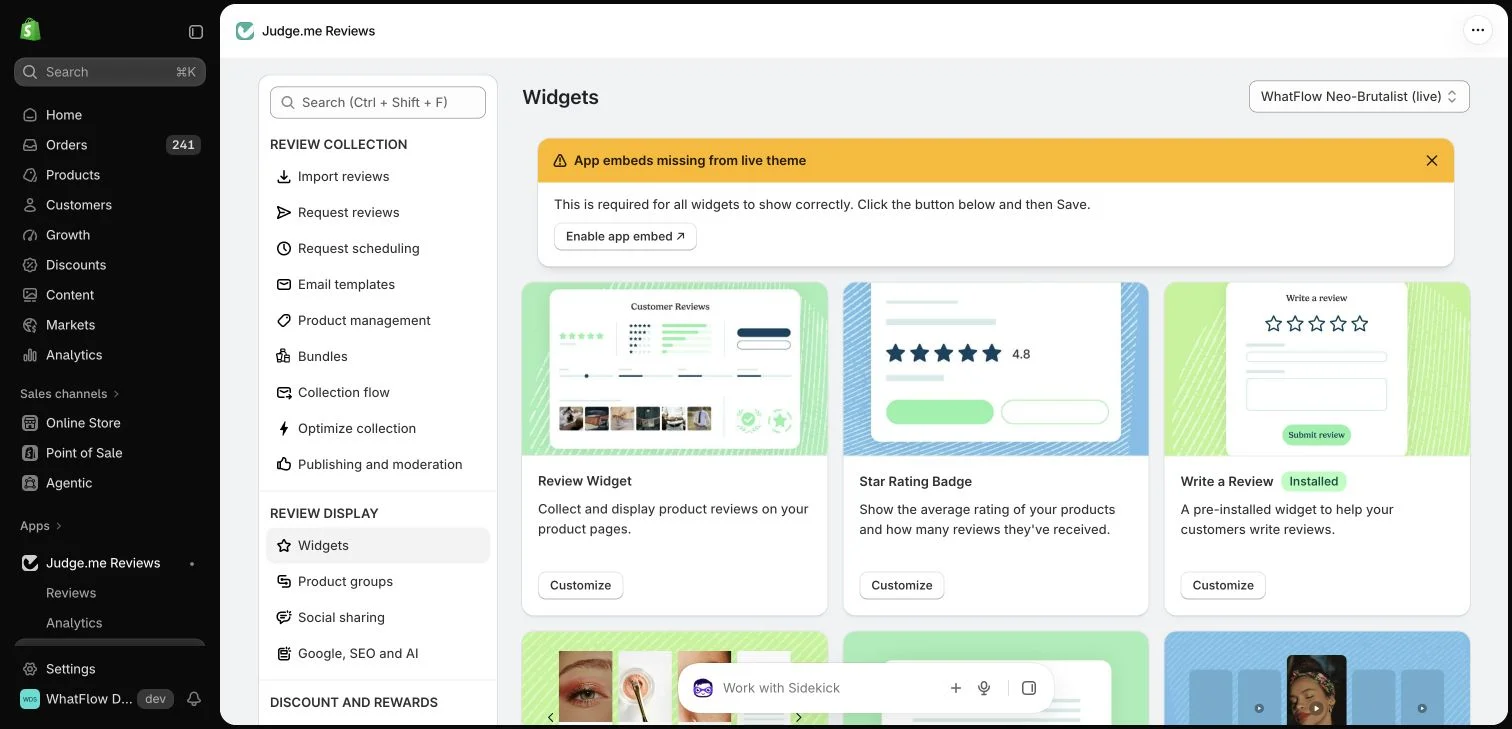
Judge.me widget configuration in the WhatFlow demo store. This setup view has no live theme embed enabled; ratings in the widget cards are interface examples.
Define the journey in separate counts
Begin with orders that qualify for your collection process. Count the requests actually sent, then the submissions received and the reviews published. These stages can differ because of contact data, timing, customer choice and moderation. A missing request should not be diagnosed as a poorly written review form.
For a simple working measure, divide submissions attributed to a defined request cohort by requests sent to that cohort. Label it precisely. If you instead divide published reviews by all orders, call that a different measure and explain what it includes. Neither calculation becomes comparable merely because both use a percent sign.
A request sent yesterday has had less opportunity to produce a review than one sent two weeks ago. Comparing unfinished cohorts can make a recent improvement appear worse. Choose a response window that fits the product and your process, and keep it consistent across the comparison.
Record the request date as well as the review date when the tools support it. A report of reviews received this month may include invitations from the previous month. That report is useful for workload, but it does not automatically measure the effectiveness of this month’s invitations.
Keep channel attribution honest
If email, WhatsApp and organic website forms all collect responses, check what each dashboard can attribute. One provider may only measure requests sent through its own system. A WhatsApp click may later produce a form submission that is not connected to the messaging dashboard at all.
Do not add several channel-reported conversions and assume every result is a different review. Use supported identifiers and clearly described attribution rules where available. When a clean connection is missing, report the limitation rather than filling the gap with an estimated success story.
The How Judge.me collects reviews reference distinguishes invited, web and imported sources, which should remain understandable in your reporting.
Diagnose the first weak stage
A low request rate suggests that many eligible buyers are never asked. Check configuration, missing contact details and exclusions. A reasonable request count with few form visits points toward timing, recognition or the next-step link. Form visits without submissions suggest another set of questions about effort or relevance.
Read a sample of customer replies alongside the counts. Someone saying “I have not received it yet” reveals a timing problem the final percentage hides. A broken product link can also affect a small group of SKUs without making the overall dashboard look obviously wrong.
Inspect review request timing when replies indicate that customers have not used the item yet.
Treat small samples as learning material
Twenty requests with three reviews should not become a permanent forecast. Differences between products, delivery routes and repeat customers can outweigh a small wording change. Keep the raw counts visible and resist presenting a minor short-term movement as a proven improvement.
A useful experiment changes one significant variable and records what else happened during the period. A large sale, a stock issue or a new carrier can affect the customer experience. Note those conditions so the next person reading the report understands why the periods may differ.
Use the result to choose one improvement
The goal is a better collection process, not a more flattering chart. Choose one fix tied to the evidence, such as correcting links, adjusting a premature request or simplifying a form. Review the next completed cohort before layering on several more changes.
WhatFlow can support the WhatsApp conversation and follow-up side of the process. Its inbox access without seat fees can help the team handle replies, but it does not make every review channel attributable automatically. Keep the measurement tied to the data your actual tools provide.
Work through one completed invitation cohort
In a hypothetical example, 120 orders qualify, 100 invitations are sent and 12 attributed submissions arrive within the chosen response window. The submission-per-sent-request rate is 12 divided by 100, or 12%. The request coverage is 100 divided by 120, or about 83%. Those figures answer different questions: whether buyers were asked and whether sent requests led to recorded submissions. They are example calculations, not expected performance.
If ten of those submissions are published, keep that publication count separate and investigate its status through the review provider. Do not substitute ten for twelve without relabelling the measure. Record invitations whose response window is still open and any organic submissions that cannot be attributed to this cohort. A WhatsApp link click is another stage, not proof of a review. Use the first missing or weak stage to choose a correction before changing invitation wording.
Before you put this into practice
Keep raw stage counts visible.
Exclude unfinished cohorts from like-for-like comparisons.
Check whether multiple tools claim the same submission.
Explore WhatFlow Business API for WhatsApp messaging and a team inbox with no seat fees. Features are included across plans, including Free; message allowances and rates differ.
Safwan Adnan is co-founder and CEO of WhatFlow. This guide is published by WhatFlow and includes its product where relevant. Worked examples are illustrative unless a caption identifies an actual demo-store configuration; they are not merchant performance results.
What denominator should review collection rate use?
Choose and label a consistent definition, such as submissions attributed to a request cohort divided by requests sent. Eligible-order and published-review ratios measure different stages.
Can I combine email and WhatsApp dashboard conversions?
Only with a clear deduplication and attribution method. Different tools can count the same outcome or miss connections between channels.