Turn customer feedback into improvements by recording the specific decision or problem behind each comment, grouping related cases and assigning a concrete action to an owner. Consider severity as well as frequency. Review comparable feedback after the change, while keeping individual support cases separate from the broader product or process fix.
Key takeaways
Group feedback around a decision the team can improve.
Treat a serious isolated defect differently from a repeated minor question.
Close individual support cases separately from systemic changes.
Customer feedback is easy to collect and surprisingly easy to leave unused. A store can have hundreds of reviews and a busy inbox while the same sizing question or packaging complaint appears every week. The missing piece is often a clear route from a repeated observation to an owned improvement.
Build a feedback loop that the team can maintain during an ordinary week. It should identify themes, distinguish frequency from urgency and connect a proposed change to the person who can make it. A large dashboard is optional; a dependable decision process is not.
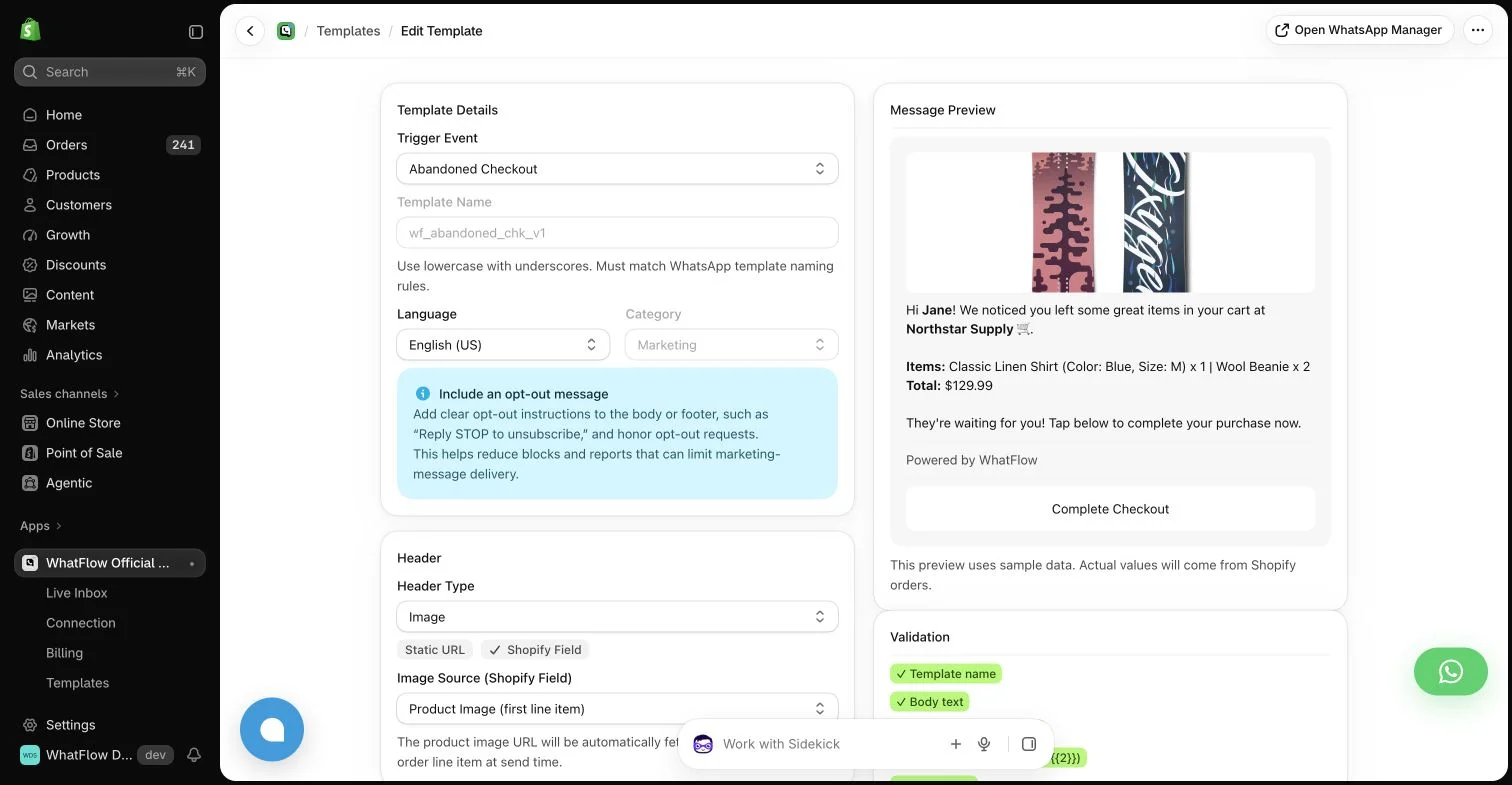
WhatFlow template editor in the demo store. Sample message data illustrates configuration, not a completed send or measured campaign outcome.
Capture the issue without spreading private details
Summarize the practical theme: unclear dimensions, a missing instruction, damaged packaging or a confusing tracking message. Keep a reference to the original case in the appropriate system rather than copying names, phone numbers and full conversations into several reports.
Reviews and support messages provide different context. A public review may describe the final experience; an inbox conversation can show where confusion began. Preserve that distinction when combining the evidence so an unresolved support exchange is not presented as a complete verdict on the product.
A theme such as “size” can be too broad. Separate choosing a size before purchase from receiving an unexpected fit afterward. One may need a clearer chart; the other may require checking measurements, manufacturing consistency or how the item is described.
Use categories that lead toward action rather than labels that simply sound analytical. “Customer did not know which charger was compatible” points toward a concrete information fix. “Low satisfaction” is harder for a colleague to turn into a useful change.
A frequently repeated minor question may deserve a page improvement. A single serious defect may deserve immediate investigation. Do not use the number of complaints as the only signal, and do not infer that silence proves the absence of a problem.
Keep the underlying sample visible. Five comments from a small launch batch mean something different from five across a large established product range. Avoid turning anecdotal feedback into an unsupported claim about every customer or the entire market.
Give the improvement an owner and a date
Choose a specific action: revise the compatibility note, change the packing checklist or rewrite a misleading notification. Assign the person who can complete it and a reasonable review date. A task called “improve customer experience” is too broad to close meaningfully.
Record the reason for the change and where it will appear. If support uses saved answers, update them alongside the public page. Otherwise the store may publish better information while the team continues sending an old explanation in private conversations.
Close individual cases and the systemic issue separately
Resolving one buyer’s replacement does not prove the packaging problem is fixed. Likewise, improving the packing process does not automatically close every open customer case. Track both outcomes so the operational improvement does not erase the person who first raised the issue.
WhatFlow’s team inbox can help colleagues continue the relevant WhatsApp conversation. Its lack of inbox seat fees can make involving another team member simpler, but the store still needs an owner and a record of the next step. Tool access alone does not complete the feedback loop.
Check whether the change addressed the cause
Review a comparable period after the improvement and read new messages about the same issue. A lower count can be encouraging, but account for sales volume and traffic changes. Ask whether the new wording or process actually answers the question customers were facing.
Share the learning with the team in plain language. A useful conclusion explains what changed, why and what remains uncertain. Over time, this routine turns reviews and support conversations into better product information and service rather than a growing archive of problems the store has learned to answer politely.
Give one feedback theme a complete action record
Hypothetical example: buyers repeatedly ask whether a bottle fits a particular cup holder. Create a theme called cup-holder compatibility, attach references to the original cases and assign the product owner to verify the base dimensions. The action is to publish those measurements and a clear compatibility explanation, rather than a vague task to improve satisfaction.
Record the publication date and update the relevant saved reply. During the next review, count related questions alongside orders for that product and read what customers still cannot determine. A lower count alone does not establish causation. WhatFlow Business API can keep the original WhatsApp conversations available to the team while the improvement record contains only the necessary theme and case references.
Explore WhatFlow Business API for WhatsApp messaging and a team inbox with no seat fees. Features are included across plans, including Free; message allowances and rates differ.
Safwan Adnan is co-founder and CEO of WhatFlow. This guide is published by WhatFlow and includes its product where relevant. Worked examples are illustrative unless a caption identifies an actual demo-store configuration; they are not merchant performance results.
Should I copy full customer conversations into a feedback spreadsheet?
Keep only the information needed for the improvement and link to the controlled source where appropriate. Avoid duplicating private contact details and attachments unnecessarily.
Does resolving one complaint prove the root cause is fixed?
No. Track the individual resolution separately from the broader product or process change, then review later evidence.