Build dropshipping customer trust by verifying product details, explaining realistic processing and shipping expectations, and taking responsibility for support even when a supplier fulfills the parcel. Tie updates to events your systems can establish. Test split shipments and missing tracking information, then use reviews and support themes to correct recurring gaps between the promise and the experience.
Key takeaways
The store remains the customer’s support point after purchase.
A fulfillment event does not prove final delivery.
Correct the source of an expectation gap before scaling promotion.
A supplier may handle the parcel, but the customer still bought from your store. Questions about product suitability, delivery and support will come back to the business whose name appears at checkout. Trust begins with explaining the parts of the experience you can actually support.
Avoid using messaging to make uncertain operations sound more reliable than they are. Start with accurate product information, realistic timing and a clear process for exceptions. A helpful conversation can explain a delay, but it cannot undo an unsupported promise made before the purchase.
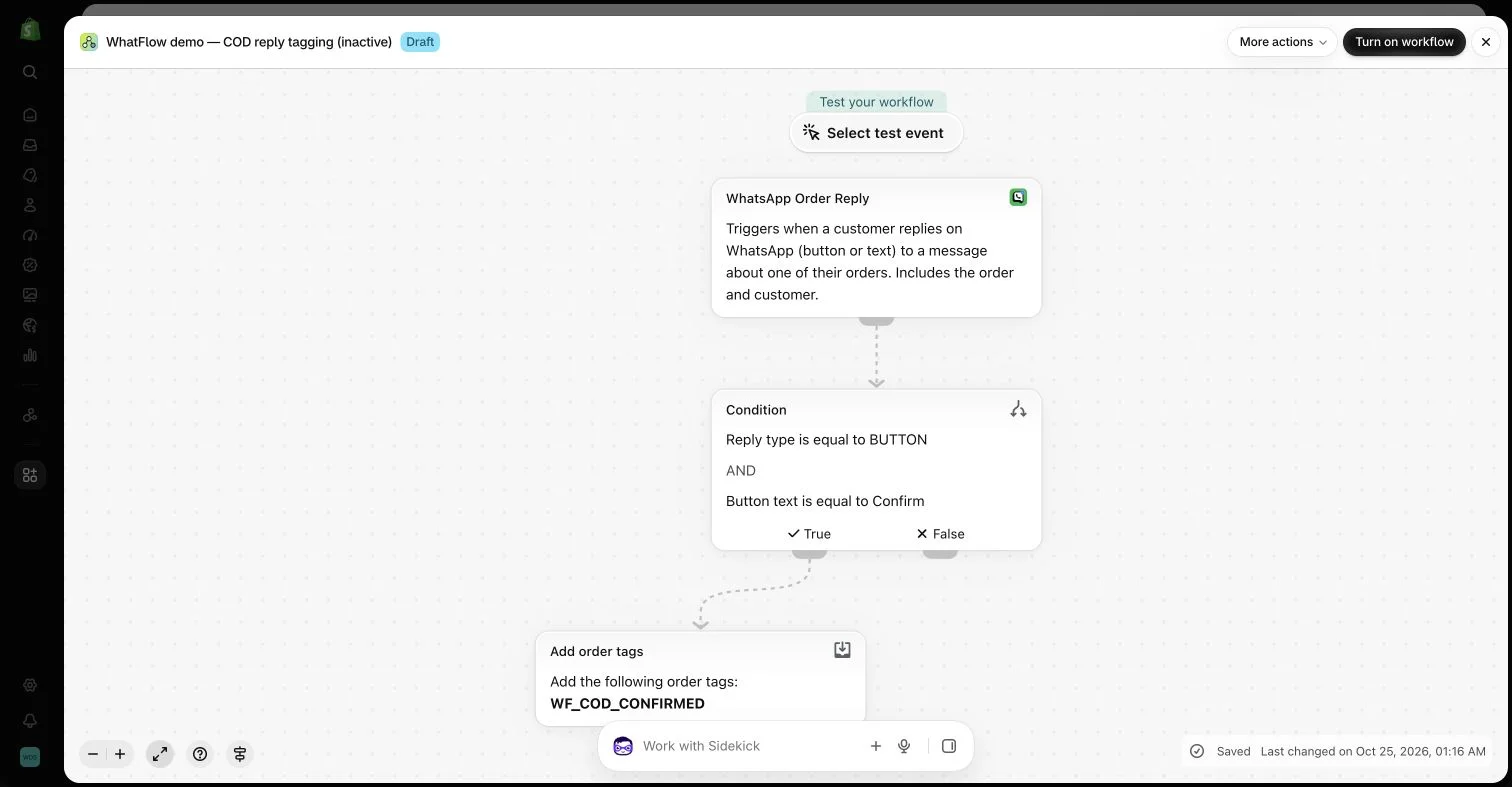
An inactive workflow in the WhatFlow demo store illustrates order-reply configuration. No customer messages or order changes were made.
Verify the product information you publish
Check the specifications and images you have the right to use. A supplier description may omit the details your customers need or apply to several slightly different versions. Confirm compatibility, dimensions and what is included before presenting the information as your store’s promise.
Do not import unrelated reviews to make a new page appear established. Review source, product association and verification should remain accurate. Customer feedback can support a decision only when the buyer understands what the evidence actually represents.
The customer needs to know the relevant processing and delivery expectations, not the details of your internal app stack. Distinguish the store’s handling stage from the carrier journey and explain when a shipment may contain separate parcels.
If a date is an estimate, say so. Avoid a blanket fast-delivery claim when routes vary significantly by destination. Check the current supplier and shipping conditions rather than copying a promise from an old promotional page.
Give order updates a reliable event source
Choose messages tied to data your systems can establish. An order record is not proof that a parcel has shipped, and a fulfillment record is not proof of final delivery. The wording should reflect the event and any uncertainty that remains.
Test representative orders, including split shipments and missing tracking information. A sequence that works for one clean example may mislead customers when the supplier process differs. Define the exception path before allowing the workflow to run at volume.
Give customers a monitored route and set realistic response expectations. A buyer should not be sent back and forth between the store and an unfamiliar supplier merely because the internal process is unclear. The team needs a way to investigate and provide the next appropriate step.
WhatFlow’s Shopify-oriented messaging and team inbox can support that conversation, with no inbox seat fees on Business API plans. The tool does not make a supplier’s stock or delivery estimate correct. Keep operational evidence connected to the answer the team sends.
Use reviews to detect expectation gaps
Read feedback about product differences, packaging and delivery alongside support questions. A repeated complaint may reveal that the public description is too broad or that one route behaves differently from the estimate. Send the theme to the person who can change the relevant process.
Keep individual resolution and broader improvement separate. Replacing one item can help that buyer without proving the supplier problem is fixed. Do not ask the customer to change a public rating as a condition of appropriate support.
Scale the promises only after checking the process
Before a busy promotion, review stock assumptions, shipping information and the team’s capacity to handle exceptions. Coordinate campaign volume with the operation the store can maintain. A larger audience can amplify an unclear promise as easily as a useful offer.
The strongest trust strategy is a repeatable experience the business can explain. Clear pages, honest reviews and accurate messages work together. They should make the actual buying process understandable rather than decorate it with assurances the supplier arrangement cannot reliably deliver.
Write split-shipment updates from known facts
Hypothetical example: a buyer orders two items supplied from different locations. The first parcel receives tracking while the second is still processing. Check what the actual order and shipment records establish, then explain that the order has separate parcels and identify the known tracking destination. Avoid describing the entire order as shipped simply because one item moved.
Keep a support note for the remaining item, its information source and the person responsible for the next check. Review the public shipping explanation if buyers repeatedly misunderstand separate parcels. WhatFlow Business API can keep WhatsApp questions in a shared inbox without seat fees, making it easier for another colleague to investigate. The reply should still reflect the supplier and carrier evidence available at that moment.
Explore WhatFlow Business API for WhatsApp messaging and a team inbox with no seat fees. Features are included across plans, including Free; message allowances and rates differ.
Safwan Adnan is co-founder and CEO of WhatFlow. This guide is published by WhatFlow and includes its product where relevant. Worked examples are illustrative unless a caption identifies an actual demo-store configuration; they are not merchant performance results.