Respond to a negative product review by acknowledging the specific issue, explaining a factual next step and moving private order details to an appropriate support channel. Apply the same moderation standard to every rating. Resolve the underlying problem on its merits, then let the customer decide whether to update their review without pressure or conditions.
Key takeaways
Acknowledge the actual complaint before explaining policy.
Investigate order details privately through an appropriate channel.
Separate support resolution from requests to change ratings.
A negative review creates two conversations at once. The customer needs a useful response to a specific experience. Future shoppers are watching how the business behaves when something goes wrong. A defensive public reply can make the second conversation worse even if the original problem is fixable.
Start by separating resolution from reputation management. Your job is to understand what happened and explain the next appropriate step. You cannot promise a positive updated review, and resolving the issue should not depend on the customer removing their criticism.
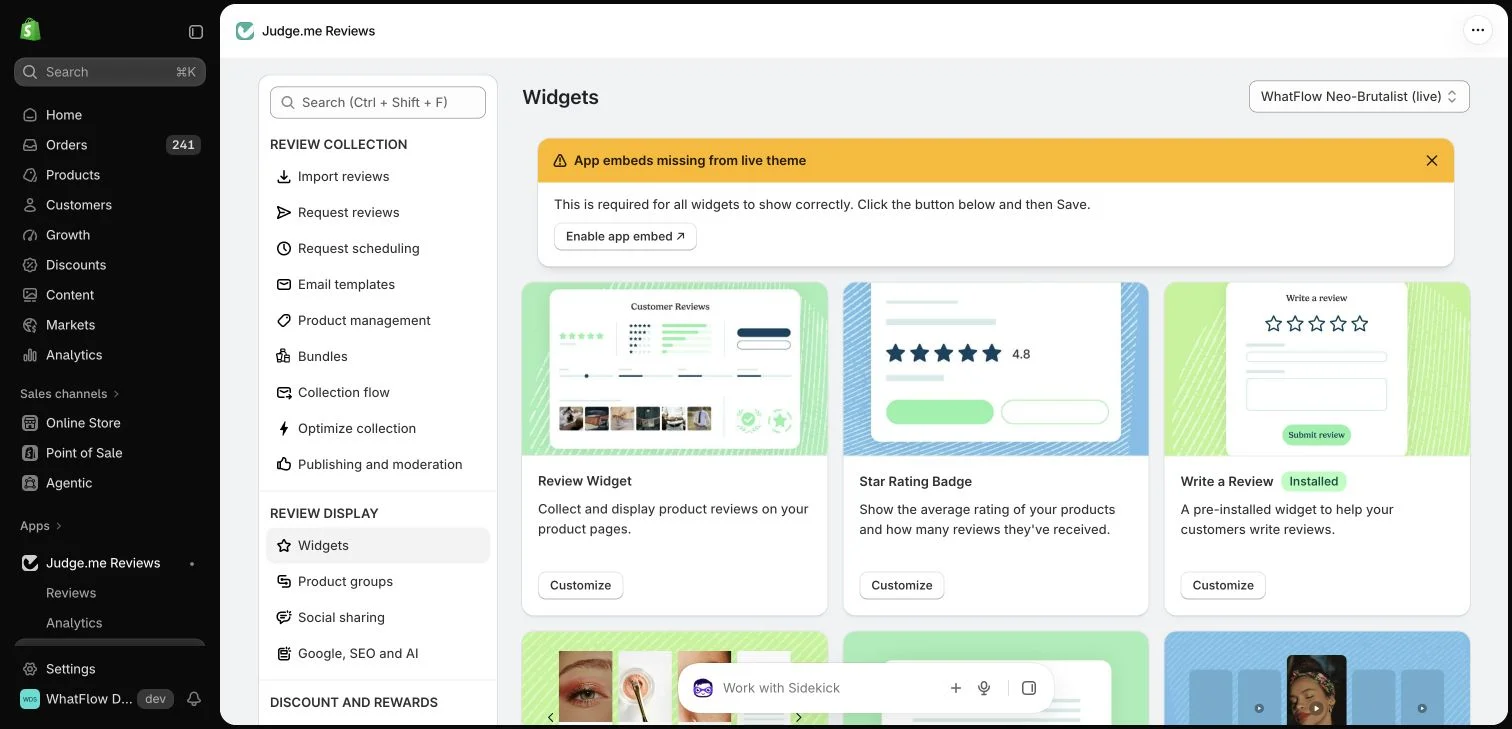
Judge.me widget configuration in the WhatFlow demo store. This setup view has no live theme embed enabled; ratings in the widget cards are interface examples.
Read the complaint before choosing a response
Identify whether the review concerns the product, shipping, expectations or the support experience. Check the relevant order privately if you have the necessary information. A complaint about an unclear size guide needs a different response from a parcel that has not arrived.
Avoid beginning with a canned explanation of company policy. Acknowledge the specific issue in plain language: “The strap arriving with a loose stitch is disappointing, and we would like to inspect it with you.” That is more useful than announcing that quality is your highest priority.
A public response should acknowledge the experience, explain an appropriate next step and make the support route clear. Do not publish the buyer’s phone number, address, order details or private correspondence to demonstrate that the business was right. Those details belong in a controlled support conversation.
For example: “We are sorry the replacement part did not fit. Please contact our support team with your order reference so we can check the version and available options.” Only state that you have contacted the customer if the team actually has. Do not imply a resolution that has not happened.
Use a private channel to investigate
The detailed conversation may need photographs, a product identifier or delivery information. Explain why each item is needed, and avoid asking for data the team already has. Record the agreed next step so another colleague can continue the case without making the customer repeat the story.
If WhatsApp is an appropriate, permitted support channel for that customer, WhatFlow’s team inbox can help keep the conversation accessible to the team. It is not permission to contact every reviewer on WhatsApp. Public review data and messaging consent are separate parts of the customer relationship.
Use Publishing and hiding reviews to understand the provider’s review statuses before applying your store’s moderation decision.
Follow the same moderation standard for every rating
Spam, private information and irrelevant content can need moderation. A low rating alone should not become the reason honest feedback disappears. Write a moderation policy that a colleague can apply consistently, then use your review provider’s supported statuses and reporting tools.
Judge.me documents separate published, pending, hidden and archived review states. The exact behavior of those states belongs to its current product documentation. Do not assume hiding a storefront review removes it from every other feed or channel where it might have been shared.
Review cases together rather than treating every critical message as an isolated exception. Repeated fit complaints may indicate an unclear product description. Repeated missing-accessory reports may point to packaging. A long response delay may mean the inbox needs a clearer owner during busy hours.
Keep a short issue log with the theme, affected product, frequency and proposed change. Avoid copying unnecessary personal details into that log. Assign a person and a review date to the improvement; otherwise the same complaint will keep receiving polished replies without a better customer experience.
Close the support loop without bargaining over the review
Tell the customer what was done and what remains open. If they choose to update the review, that decision is theirs. Do not make a replacement or other appropriate support outcome conditional on a new rating. The resolution and the public feedback should remain honest.
A careful reply does not guarantee that every reader will buy. It does show that the store can acknowledge a problem and follow through. Over time, that operational consistency is more credible than a page that appears to have never disappointed anyone.
Use a reply-to-resolution case note
Imagine a customer saying a replacement lid still leaks. A useful public reply can acknowledge that the replacement has not solved the problem and offer a clear support route. It should not publish the order history to prove how much work the team has done. Privately, ask for the lid version or evidence needed to investigate, using information already held wherever possible. Avoid repeating the same request at each handoff.
Keep a short controlled note covering the reported problem, what has been checked, the next decision owner and when the customer will hear back. If the issue reveals a recurring compatibility error, assign a separate product-page or fulfillment fix. When the case closes, record the actual resolution rather than “review recovered.” WhatFlow can help colleagues continue an appropriate WhatsApp conversation, but the public review remains the customer’s account of the experience and the provider controls its editing process.
Before you put this into practice
Write a specific public acknowledgment.
Name the next decision and its owner.
Check repeated complaints for a product or process fix.
Explore WhatFlow Business API for WhatsApp messaging and a team inbox with no seat fees. Features are included across plans, including Free; message allowances and rates differ.
Safwan Adnan is co-founder and CEO of WhatFlow. This guide is published by WhatFlow and includes its product where relevant. Worked examples are illustrative unless a caption identifies an actual demo-store configuration; they are not merchant performance results.
Use a consistent moderation policy for legitimate issues such as spam or private information. A negative opinion alone should not be treated as a reason to suppress honest feedback.
Can I ask the customer to remove the review before helping?
Keep appropriate support separate from review changes. Do not make resolution conditional on deleting criticism or increasing a rating.