A useful small-store metrics routine starts with a few operational decisions and ends with one owned action. Keep raw counts, definitions and date ranges beside rates, review purchase stages and unresolved support cases, and include messaging costs. Add stock and campaign context so a short-term movement becomes a reason to investigate rather than an unsupported explanation.
Key takeaways
Choose measures that help the team make an actual decision.
Keep definitions, raw counts and operational context visible.
Finish each review with one owner and a review date.
A small store can spend more time assembling dashboards than acting on them. The solution is not to ignore the numbers. It is to choose a short routine where each measure helps answer an operational question the team can actually address.
Begin with the decisions you expect to make: whether checkout needs attention, whether support is keeping up and whether a campaign deserves another send. A useful report combines counts, context and customer feedback rather than treating every percentage as a complete explanation.
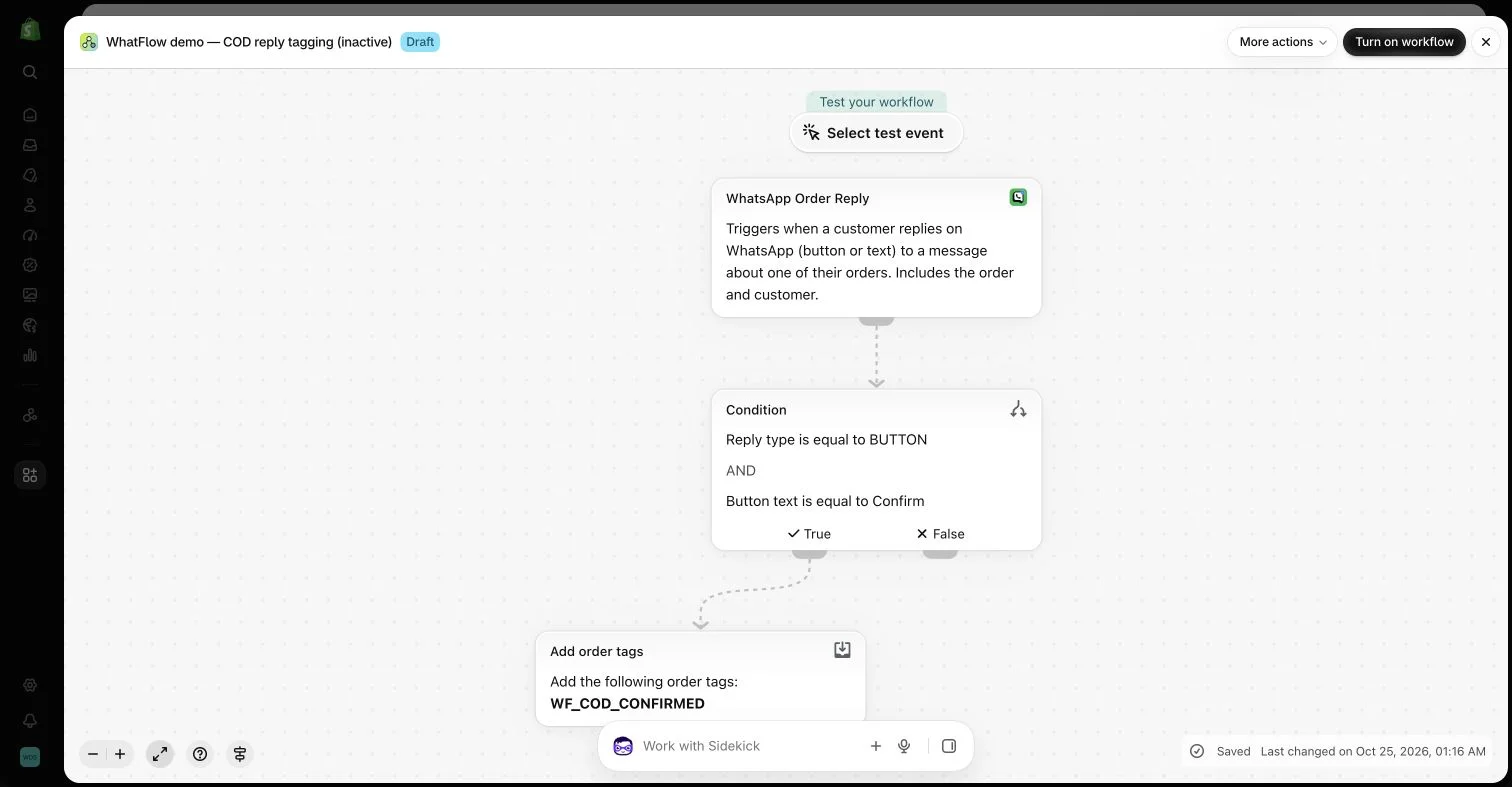
An inactive workflow in the WhatFlow demo store illustrates order-reply configuration. No customer messages or order changes were made.
Keep the definitions beside the numbers
Write what an order, a resolved conversation or an attributed purchase means in the report. Different apps can use different time windows and rules. A value with the same label in two dashboards may not represent the same set of events.
Keep raw counts visible alongside rates. Three conversions from a small group can create a dramatic percentage without supporting a confident forecast. Consistent definitions make a modest report more useful than a large table that no one can reproduce.
Look for the point where a customer’s progress changes, using the events your analytics setup actually records. A traffic decline and a checkout completion problem need different investigations. Do not treat a lower order total as proof that the product page alone caused the change.
Add operational context such as stock, promotions and shipping issues. A product unavailable for part of the week can change the result without any difference in customer interest. A short note can prevent an elaborate but incorrect interpretation later.
Include support workload and unresolved cases
Count new conversations and review what remains open. A fast first response is useful, but it does not establish that the actual question was resolved. Distinguish waiting for the customer from waiting for an internal decision or external update.
Read a small sample of messages. Repeated questions about the same compatibility detail may justify a page change more directly than another dashboard chart. Keep the sample private and summarize the theme rather than distributing personal conversation details.
Check WhatsApp Platform pricing for the applicable recipient-market and message-category charges before comparing the forecast with actual billing.
Measure the cost of customer contact
Review message volume, applicable charges and the staff work created by campaigns. Compare the actual workload with the forecast. A sequence that sends several reminders per customer can cost more than a plan based only on the initial audience count.
WhatFlow Business API includes features across plans and no inbox seat fees, with allowances and rates differing. That simplifies part of the team-cost model, but message charges and other tools still belong in the calculation. Do not assume that a low subscription makes every campaign worthwhile.
Reviews can reveal product expectations and service problems. Separate product-specific themes from store-level concerns. A carrier change may explain a rise in delivery complaints without establishing that the product itself became worse.
Track a theme with enough context to choose an action, including the affected product and the proposed owner. Avoid interpreting a handful of comments as a representative market study. Customer feedback can identify a useful hypothesis without proving its prevalence across every buyer.
End the routine with one owned action
Choose the most useful next change, state why and assign the person who can make it. Record when the team will review the result. A weekly report that produces no decision can gradually become another task the founder feels obliged to complete.
The best routine is small enough to survive a busy week and clear enough for another colleague to run. It should help the store investigate the right problem, make a reasonable improvement and understand what remains uncertain after the change.
Run a review from question to next action
Imagine a fictional weekly report showing fewer orders and more product questions. Before rewriting the checkout, check whether traffic changed, a popular variant was unavailable or a campaign attracted a new audience. Read a small controlled sample of questions and summarize themes without personal details. If most concern the same missing compatibility measurement, that is a concrete investigation path rather than proof that the whole storefront needs redesigning.
Write the next action as “product owner confirms the measurement and updates the relevant page,” with a date to review the result. Keep the order count, traffic context and compatibility-question count defined consistently for the next period. Add campaign messages and related charges if outreach contributed to the workload. WhatFlow’s no-seat-fee model simplifies the inbox-user part of the budget, while actual message usage and staff follow-through still belong in the operating picture.
Before you put this into practice
Check stock and promotions before interpreting changes.
Explore WhatFlow Business API for WhatsApp messaging and a team inbox with no seat fees. Features are included across plans, including Free; message allowances and rates differ.
Safwan Adnan is co-founder and CEO of WhatFlow. This guide is published by WhatFlow and includes its product where relevant. Worked examples are illustrative unless a caption identifies an actual demo-store configuration; they are not merchant performance results.